 Shaka
Isla de Flores: a night alone on the island of the lazaretto, the lighthouse and the crematorium
About 20 kilometers off the coast of Montevideo there's an island of rocks, a lighthouse and buildings eaten away by salt: Isla de Flores. It was a stopover for slave ships, a quarantine station for immigrants, it had a crematorium, and it was a prison for political prisoners. I stayed alone on the island for a night, and even slept inside the lighthouse, to see whether the paranormal phenomenon was as real as people say.
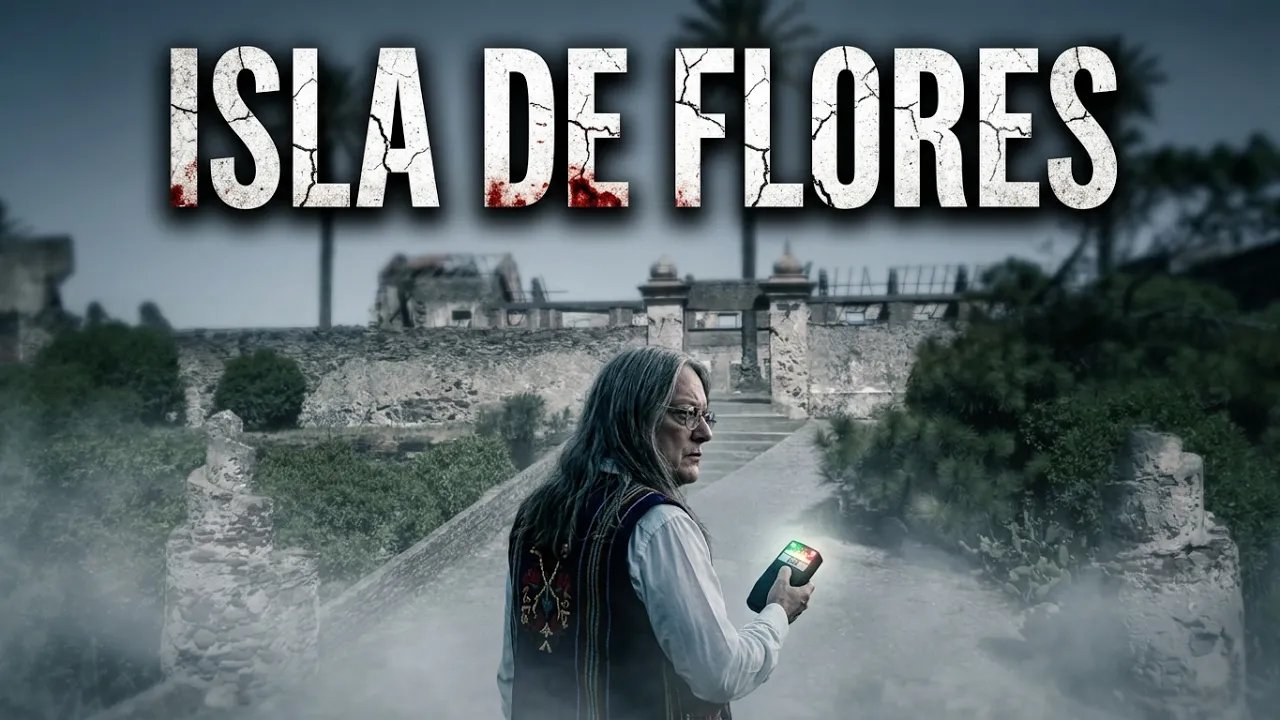
In the video, the island's history is narrated by Néstor Ganduglia, who generously agreed to tell it. It's a huge honor for me that he wanted to collaborate like this. This page is also in his memory. The videos are in Spanish; this page is the full story in English.
An island without flowers
The name is misleading. There are no flowers on Isla de Flores ("Island of Flowers"): just rocks battered by sun and tide, a few isolated palm trees and vegetation barely a few centimeters tall. The name comes from Sebastián Gaboto, who arrived at Easter (Pascua Florida) in 1527. It's actually three islands, which join together at low tide.
The lighthouse is Portuguese in origin and has been in service since 1828. It has a story of its own: it's tied to the 1819 Convenio de la Farola, the agreement with the Portuguese of Brazil under which the Banda Oriental (today's Uruguay) lost territory. That's why it's said to be one of the most expensive lighthouses in history.
The island of sorrows
For a long time the island was a stopover for ships carrying enslaved people. Before selling them in Montevideo, they were brought ashore here, and anyone who fell ill was left to die on a nearby islet.
Then came the epidemics: yellow fever, cholera, typhus. To stop them, the island became a sanitary checkpoint. A building was put up and named, with some irony, the "Immigrants' Hotel", but it was really a lazaretto: every ship that arrived, full of Europeans looking for a better life, had to stop and quarantine for up to 40 days.
Each island had its role. On the first and largest, families waited, praying no symptoms would appear. If they did, people were taken to the second, the island of the sick, from which it was very hard to come back. And on the third were the cemetery and the crematorium, whose chimney still stands. Many families were broken apart between one island and another.
On top of that, in the 1930s, under Gabriel Terra's government, the island was also a prison for political prisoners. Many of those who passed through, whether sick, enslaved or imprisoned, carved their names, messages and words of love into the walls.
Since 2018 it has been a national park, and for decades its only regular inhabitants have been the lighthouse keepers.
"If you go with your sensitivity alive and your ear attentive, you'll meet the ghosts of memory." — Néstor Ganduglia
The legends
- The lighthouse keeper who, the story goes, threw himself from the top of the lighthouse, and who is said to still be inside.
- In the room with beds inside the lighthouse, a shadow that comes out of the bathroom and fades into a wall, and knocks heard in one corner.
- A girl said to run around the island, who supposedly took her own life. According to the information I found, if it happened, it wasn't in the lazaretto where the immigrants stayed, as is usually told, but on the other side, in the building where the military staff lived.
- Screams at night, moaning, and even people who say they can still smell the burning flesh from the crematorium.
Part 1: the lighthouse
I started as soon as night fell, at the lighthouse. I left a REM-Pod and a night-vision camera, and in the room with the beds, where the shadow story comes from, I turned everything off to see if it would appear and did an SB7 Spirit Box session. One of my milligauss meters got stuck at zero, so I didn't count it. At the lighthouse I couldn't record anything clear.
Part 2: the lazaretto
Then I went to the first island, where the "healthy" people stayed during quarantine. I left a motion-sensor camera with night recording and walked through the buildings asking that, if anyone was there, they touch the equipment.
Until almost two in the morning everything was very still: no readings, no uncomfortable feeling, no voices, no screams. Until, in one of the buildings, the green light on one of the devices came on. I asked if someone was touching it, asked them to stop, and then to do it again. That moment I do count as evidence.
The night inside the lighthouse
When I finished, I went to sleep inside the lighthouse, with everything off, while I left the equipment outside measuring. And there, trying to sleep, I felt that someone was with me: a strong presence that made me uneasy and wouldn't let me sleep.
Was it real? It may have been my imagination in the moment: alone, at night, on an island with so much history, in the very lighthouse of the keeper's legend. I can't claim otherwise. But I'm telling it, because it's what I felt.
What I take with me
Isla de Flores is one of the places with the most history in Uruguay, and not all of it is pretty. Beyond the paranormal, walking it means walking among what the enslaved went through, the immigrants who arrived full of hope and the families broken apart between one island and another. From that night I take with me a green light that came on when I asked, and a presence that wouldn't let me sleep.
The videos (in Spanish)

Part 1: alone on Isla de Flores, the investigation at the lighthouse · Watch on YouTube

Part 2: the history narrated by Néstor Ganduglia and the investigation at the lazaretto · Watch on YouTube
This investigation was also covered by the press: El País, Domingo supplement (in Spanish).
If you visit
Isla de Flores is a national park and access is regulated, so find out the details before you go. And as always, be respectful: there's a lot of pain among those ruins.